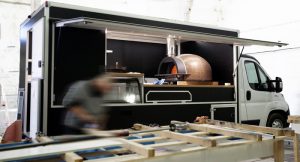
When you start out in the mobile catering business, choosing the right vehicle quickly becomes a headache. Between converted trucks, food truck trailers and three-wheelers, it’s hard to find your way around. Each solution has its advantages, depending on your concept, your budget and your ambitions. Let’s decipher the different options available to you to turn your culinary dream into a profitable mobile business.
What you need to know before choosing
- The food truck: a complete, autonomous solution, ideal for ambitious concepts ;
- The trailer: more economical to buy, perfect for beginners on a tight budget;
- The scooter: ultra-mobile for city centers and markets, a simple but effective concept;
- Vintage vehicles: guaranteed visual impact, perfect for standing out at events ;
- Decisive criteria: budget, type of kitchen, area of activity and local regulations;
The food truck: the all-in-one solution for ambitious entrepreneurs
The food truck is the reference choice for those who want to get serious about mobile catering. Based on a van chassis (Citroën Jumper, Renault Master, Iveco Daily), it offers optimized workspace and complete autonomy.
As far as advantages are concerned, the first thing you’ll appreciate is its total mobility. No need for a towing vehicle, you can leave when you want, where you want. The kitchen space allows you toinstall a full range of professional equipment: plancha, fryer, refrigeration, generous work surface. Some models even integrate digital management systems to control temperature, lighting and energy consumption via a mobile app.
The downside? The initial investment remains substantial. Expect to pay between €80,000 and €150,000 for a new, fully-equipped truck. You’ll also need a HGV license if you exceed 3.5 tonnes GVW. But for an elaborate street food concept or intensive activity, this is often the most profitable choice in the long term.
The food truck trailer: the smart way to get started
More and more entrepreneurs are turning to trailers for their financial flexibility. Towed by your own vehicle or a van, it lets you test your concept without breaking the bank.
Budget-wise, it’s actually more affordable. A fully-equipped food truck trailer starts at around 40,000 euros, half the price of a truck. You also keep your towing vehicle for other uses. Practical when you’re just starting out and need to optimize every euro.
However, space remains more limited. It’s hard to fit an elaborate kitchen into 10 to 15 m². The trailer is perfectly suited to simple concepts: pancakes, waffles, sandwiches, hot drinks. For more complex preparations, it quickly becomes a tight squeeze. Another point to bear in mind: maneuvering the trailer requires a bit of practice, especially in the confined spaces of markets.
Scooters: the star of city centers
It’s impossible to talk about mobile catering vehicles without mentioning the scooter. This little three-wheeled machine is revolutionizing the approach to mobile sales, particularly in dense urban environments.
Its major advantage? Incomparable agility. Where trucks and trailers struggle to squeeze in, the three-wheeler goes everywhere. Pedestrian squares, narrow streets, parks: it’s got access to the most popular spots. Some electric models, like the Ape V-Curve, can even be used in low-emission zones.
In terms of investment, it’s also the most reasonable. A scooter fitted out for catering costs between 15,000 and 35,000 euros, depending on the equipment. Perfect for testing a simple street food concept: coffee, ice cream, light snacks. However, limited space means you’ll have to stick to basic preparations. Forget elaborate cuisine, and focus on the quality and originality of your products.
Vintage vehicles: when authenticity makes the difference
In an increasingly competitive mobile catering market, it’s crucial to stand out from the crowd. That’s where vintage vehicles come in, real rolling jewels that catch the eye and leave a lasting impression.
A restored Citroën Type H or a converted Volkswagen van immediately generates emotion. These vintage vehicles, brought up to date with modern equipment, create a unique customer experience. At festivals, Christmas markets or corporate events, the visual impact is guaranteed.
Beware, however, of technical constraints. Renovating a vintage vehicle requires time and expertise. Spare parts can be hard to find. In terms of budget, you can expect to pay between €60,000 and €120,000 more than for an equivalent new vehicle, depending on its initial condition and desired level of finish. But for certain top-of-the-range concepts, this investment is fully justified.
How do you choose according to your concept and constraints?
The choice of vehicle depends above all on your project. For a pancake business at local markets, a scooter will suffice. If you’re targeting festivals with a gourmet burger concept, look for a well-equipped truck.
Also analyze your business zones. Historic city centers with their narrow lanes favor smaller vehicles. Outlying commercial zones are more accepting of large trucks. Find out about local regulations: some communes limit the size of vehicles authorized.
When it comes to your budget, don’t underestimate the hidden costs. Insurance, maintenance, fuel, parking: they all add up. An electric scooter can be more economical to run than a large diesel truck, even if the initial investment is different.
Think scalability too. Starting small allows you to validate your concept before investing heavily. There’s nothing to stop you starting out with a trailer and upgrading to a truck once your business has stabilized.
Frequently asked questions about mobile catering vehicles
-
Quel permis faut-il pour conduire un food truck ?
Excellente question ! Pour un véhicule de moins de 3,5 tonnes (PTAC), votre permis B suffit. Au-delà, il faut le permis C ou C1 selon le poids. La plupart des food trucks restent sous les 3,5 tonnes pour éviter cette contrainte. Pensez aussi à vérifier les restrictions de circulation dans votre zone d'activité.
-
Peut-on transformer n'importe quel véhicule en food truck ?
Théoriquement oui, mais attention aux normes ! L'aménagement doit respecter la réglementation sanitaire stricte. Mieux vaut faire appel à un professionnel agréé qui connaît les exigences : évacuation des fumées, plan de travail inox, point d'eau, réfrigération. Un aménagement "fait maison" risque de ne pas passer les contrôles.
-
Combien coûte l'entretien d'un véhicule de restauration ambulante ?
Comptez environ 3 000 à 5 000 euros par an pour un camion, moins pour une remorque ou un triporteur. L'équipement de cuisine demande un entretien régulier : nettoyage approfondi, vérification des systèmes de froid, maintenance des appareils de cuisson. N'oubliez pas les contrôles techniques renforcés pour les véhicules commerciaux.
-
Vaut-il mieux acheter neuf ou d'occasion ?
Tout dépend de votre budget et de votre expérience. Le neuf offre garanties et tranquillité d'esprit, mais coûte cher. L'occasion peut être intéressante si vous savez évaluer l'état du matériel. Méfiez-vous des bonnes affaires trop belles : un équipement défaillant peut vite coûter plus cher qu'un véhicule neuf. Dans le doute, faites expertiser avant d'acheter.
-
Quelle est la durée de vie d'un food truck ?
Bien entretenu, un food truck peut rouler 10 à 15 ans sans problème majeur. L'équipement de cuisine a généralement une durée de vie plus courte : 5 à 8 ans selon l'intensité d'usage. Prévoyez un budget renouvellement pour maintenir votre outil de travail en bon état. Un véhicule bien entretenu garde aussi une meilleure valeur de revente.