When you embark on the adventure of a pizza food truck, one question almost always comes up right from the start: which oven to install in your truck?
This choice is far from trivial. It has a direct influence on the quality of your pizzas, the pace of your service, your operating costs and even the conformity of your business. With the benefit of hindsight and the experience of many project owners, one thing is clear: the oven plays a central role in the success of a pizza truck.
Wood-fired, gas-fired or electric: each solution has its advantages… and its limitations. The problem is that not all ovens are compatible with in-vehicle use. Weight, size, energy autonomy, safety constraints and regulatory requirements quickly limit the possibilities. So it’s better to make the right choice from the outset, rather than having to correct a costly mistake once you’re on the road.
What you need to know before choosing
- Maximum weight: Your pizza truck may not exceed 3,100 kg to keep your B licence.
- Energy autonomy: Choose solutions that are not dependent on the power grid
- Compliance: All equipment must comply with homologation standards
- Profitability: Calculate operating costs over 12 months, not just the purchase price.
- Practicality: Your oven should be able to take out 4 to 6 pizzas simultaneously at peak times.
The wood-fired oven: authenticity comes at a price
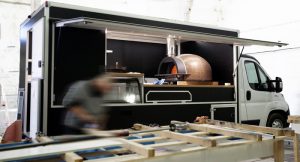
Let’s be honest: the wood-fired oven is the stuff of dreams. The smell of smoke, the crackling fire, that artisanal image that customers love… On paper, it’s seductive. In a pizza truck, the reality is a little more demanding.
Constraints not to be underestimated
Weight is the first obstacle.
A mobile wood-fired furnace generally weighs between 300 and 500 kg. To this must be added the wood stock, at least 50 kg. As a result, there’s very little room for maneuver when it comes to the vehicle’s total authorized weight, with a direct impact on homologation and safety.
Wood logistics is a real issue.
You need to think about storage, transport and regular supply. Quality wood costs between €0.15 and €0.25 per kilo, which works out at around €15 per service for a hundred pizzas. Not insignificant for a full season.
Safety requires constant attention.
Soot, embers, incandescent projections… In the confined space of a truck, the risks of fire exist. A wood-fired oven requires specific installations, with two separate systems: one to evacuate smoke and another to dissipate the oven’s heat.
The real advantages of a wood-fired oven in a food truck
Taste, above all.
Wood-fired cooking brings an inimitable flavor that many customers are looking for. It’s this little detail that often makes all the difference, and enables higher prices to be charged. In fact, project owners who have made this choice charge an average of 15% more for their pizzas than those equipped with a gas oven.
The marketing argument is also very strong.
Displaying “wood-fired pizza” on a truck is immediately reassuring and attractive. In a context where everything seems standardized, this promise of authenticity attracts the eye… and customers.
Annual operating costs (estimate)
For approximately 200 services per year (4 services per week):
- Wood: €3,000 ;
- Specialized maintenance: 800 € ;
- Increased insurance: €400 ;
Total: approximately €4,200 per year
The gas oven: the smartest compromise
If we had to recommend a solution to the majority of project owners, the gas oven would come out on top. In practice, it offers one of the best balances between performance, ease of use and profitability.
Why gas is so attractive to professionals
Rapid heating makes all the difference.
In around 15 minutes, the oven reaches 400°C, compared with 40 to 45 minutes for a wood-fired oven. When you need to be ready for a lunchtime service, or to deal with unforeseen circumstances, this time-saving is invaluable.
Temperature control is a real comfort.
With gas, settings are precise and stable. No more variations linked to fire or wood quality. You can control your cooking down to the degree, guaranteeing the consistency your customers appreciate… and you.
Autonomy is more than sufficient for mobile use.
A 13 kg gas cylinder can cook around 150 to 200 pizzas. In most cases, this covers a full day’s service with no supply constraints.
Points to watch out for
Weight is another factor.
Depending on the model, a gas oven weighs between 150 and 250 kg. This is considerably more manageable than a wood-fired oven, but remains a key factor in calculating the truck’s total weight and certification.
The technical constraints are similar to those for wood.
Two drains are required: one for combustion gases, the other for the heat released by the oven. To avoid unpleasant surprises, these elements must be integrated right from the design stage.
The cost of gas varies from zone to zone.
Depending on supplier and region, a 13 kg bottle generally costs between €25 and €35. An item to keep an eye on, but a predictable one.
Annual operating costs (estimate)
For approximately 200 services per year:
- Gas: €2,400 ;
- Maintenance: €300 ;
- Regulatory inspections: €200 ;
Total: approximately €2,900 per year
The electric oven: simple... but quickly restrictive
On paper, the electric oven has a lot going for it. No fuel to manage, no fumes, easy cleaning. However, on a pizza truck, this solution quickly reveals its limitations.
Clear benefits
Safety first.
With electric, there’s no flame, no gas, no fuel. The risk of fire is reduced, and there are no combustion gases to evacuate. A single heat outlet is all that’s needed, simplifying layout.
Cleanliness is a real plus.
No soot, no ash, no combustion residues. The workspace remains clean, a point often appreciated during health inspections.
Precision cooking is a must.
Temperature control is very fine, comparable to that of gas. Some professional ovens even offer automated programs for greater consistency.
The real black spot: energy autonomy
This is where things get complicated.
A professional electric oven consumes between 6 and 12 kW. To ensure just four hours of autonomy, you need a generator of at least 15 kW. That’s an extra 200 kg… and a noise level that’s far from discreet.
Lithium batteries are an alternative, but at a high cost.
For comfortable autonomy, the investment is generally between €15,000 and €25,000. A substantial budget, especially at launch.
Finally, electric power makes you totally dependent on your energy source.
A generator or battery failure, and service comes to a screeching halt. In a food truck, this dependence can quickly become an operational risk.
Annual operating costs (estimate)
For about 200 services per year with a generator:
- Group fuel: €1,800 ;
- Group maintenance: 600 € ;
- Oven maintenance: €200 ;
Total: approximately €2,600 per year
Annual operating costs (estimate)
For about 200 services per year with a generator:
- Group fuel: €1,800 ;
- Group maintenance: 600 € ;
- Oven maintenance: €200 ;
Total: approximately €2,600 per year
Full comparison: all criteria side by side
|
Criteria |
Wood oven |
Gas oven |
Electric oven |
|
Total weight |
350-500 kg |
150-250 kg |
80-150 kg |
|
Heating time |
45-60 min |
15-20 min |
10-15 min |
|
Autonomy |
4-6h (depending on wood stock) |
6-8h (13kg bottle) |
2-4h (depending on battery/group) |
|
Operating cost/year |
4 200€ |
2 900€ |
2 600€ |
|
Purchase price |
8 000-15 000€ |
5 000-12 000€ |
3 000-8 000€ |
|
Easy maintenance |
Complex |
Moderate |
Simple |
|
Marketing argument |
Excellent |
Good |
Low |
Selection guide: which oven for your concept?
Let’s get down to business. The right oven depends above all on your positioning, your constraints in the field and your budget. With the benefit of several years’ experience supporting project owners, certain profiles come up time and time again.
You’re aiming for a high-end positioning
The wood-fired oven makes sense… as long as you accept its constraints.
It reinforces your artisanal image and allows you to charge premium prices. On the other hand, you’ll need a truck of sufficient size to absorb the weight of the oven and wood, and you’ll have to accept more demanding logistics.
You’re looking for the best balance between performance and practicality
The gas oven is clearly the most versatile choice.
It’s the solution chosen by the vast majority of projects that work over the long term. Fast, reliable and adaptable to almost any location, it offers real freedom of operation on a daily basis.
You’re starting out on a limited budget
Electric can be a good starting option… under certain conditions.
It’s a good idea if you’re working on sites equipped with an electrical connection. Failing that, a well-maintained second-hand gas oven is often the safest way to get started without blowing the budget.
You mainly target corporate events
Electricity becomes particularly interesting.
No smoke, little nuisance, a clean and controlled image: it’s perfectly suited to corporate environments. Just remember to provide a back-up energy solution to avoid any interruption in service.
Trends 2026: wood fires make a comeback
Paradoxically, while practicality is pushing towards gas and electric, demand for the authentic is exploding. Consumers are willing to pay more for a “real” experience.
This premium trend is turning the wood-fired oven into a real competitive argument. My customers with wood-fired ovens have margins 20% higher than the average.
At the same time, manufacturers are innovating. New wood-fired ovens are lighter (some models weigh less than 250 kg), more efficient and safer. The gap with gas is closing.
On the electric side, the arrival of high-capacity batteries is changing the game. Soon, range will no longer be a major obstacle.
Ready to equip your pizza truck?
The choice of oven plays a key role in the success of your project. Wood-fired for a high-end artisanal image, gas for its versatility, electric for its simplicity: each solution responds to a precise use and a particular context.
Before making a decision, start by defining your positioning. Do you want to focus on authenticity, flexibility or ease of day-to-day operation? The right oven is the one that supports your strategy, not the one that imposes additional constraints.
Keep one thing in mind too: in food trucks, consistency makes all the difference. A reliable oven that’s under control and adapted to your rhythm of service is always better than a more ambitious piece of equipment that’s difficult to operate.