Adopting a vintage style for your mobile restoration project is a powerful marketing lever to instantly capture attention. At
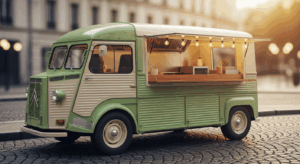
For entrepreneurs wishing to combine the cachet of the old with the serenity of the new, our sales representatives offer the Citroën Type H for sale. This iconic model creates a strong emotional connection with your customers, while guaranteeing a modern technical infrastructure. Opting for a retro-design food truck from Ecomag means choosing the efficiency of a ready-to-use vehicle without the mechanical hazards of conventional catering.
What you need to know before taking the plunge
Capital investment: budget between €15,000 and €50,000. This amount varies drastically depending on the condition of the chassis and your equipment requirements. A second-hand food truck may be an alternative, but vintage requires a rigorous equipment budget.
Commissioning time: Allow at least 6 months. This is a critical parameter for your cash flow: during this period, the vehicle generates no sales.
Regulatory compliance: VASP (Véhicule Automoteur Spécialisé) approval is a strict legal requirement. Without it, your mobile business is in breach of the law. Our teams ensure that every truck layout scrupulously complies with these standards.
Technical mastery: A successful project requires synergy between mechanical, electrical and bodywork engineering. This is whereEcomag comes in: we secure the technical side and the interior installation to deliver a ready-to-use work tool.
Marketing impact: This is the major benefit. A Citroën Type H isn’t just a truck, it’s a customer magnet that reduces your advertising acquisition costs thanks to its immediate appeal.
Why choose a vintage vehicle for your food truck project?
Authenticity is the driving force behind your visibility. In a saturated market, a vehicle with a retro design breaks with industrial uniformity and tells an immediate story. Our account managers see the impact of a Citroën Type H on a daily basis: its iconic silhouette evokes craftsmanship and know-how, building instant trust with the consumer.
Increased marketing profitability
The emotional dimension of vintage is a growth gas pedal. Your customers aren’t just buying a product; they’re buying into an experience that they’re sharing on their social networks. This user-generated content is powerful organic advertising that reduces your marketing costs.
Ecomag pragmatism: securing your work tools
However, passion should not overshadow economic viability. An old vehicle can present heavy mechanical constraints. That’s why we at Ecomag have chosen not to restore old vehicles, but to concentrate on what’s essential:customizing trucks to meet the strictest health and safety standards.
From a practical point of view, models such as the Type H or the Peugeot J7 offer optimized interior volumes. Our team transforms these volumes into ergonomic professional kitchens, combining the charm of the old with the robustness of modern equipment for intensive use.
Note from our experts: For a successful entry into the market, don’t neglect the financial aspect. Consult our guide on the price of a food truck to validate your investment envelope.
The star models of vintage mobile catering
Your choice of carrier determines your company’s operational capacity. At Ecomag, we analyze the technical characteristics of each model to ensure consistency between your concept and the reality on the ground.
The Citroën Type H: The absolute reference. A must-have, its iconic silhouette offers optimum load volume and headroom for food truck catering. It’s the model that our sales managers give priority to selling, because it combines a strong visual impact with great modularity. It’s a sound investment for intensive business.
The Volkswagen Combi: the “Light Food” choice. More compact, the Combi is ideal for coffee truck or ice cream concepts. While its appeal is immense, its limited volume calls for meticulous layout engineering.
Peugeot J7 and Renault Estafette: the pragmatic alternative. These models offer an excellent cost/authenticity ratio. The J7, in particular, is appreciated by our technical team for its generous interior volume, enabling ergonomic and functional store truck layout.
Citroën C25 and Peugeot J5: the financial compromise. For the budget-conscious, these 80s vehicles are rational solutions. They offer superior mechanical reliability and easy day-to-day maintenance, while retaining a retro look that customers appreciate.
Ecomag’s opinion: Whatever model you choose, don’t forget that the conversion must comply with VASP homologation standards. We don’t restore old bodywork, but we do guarantee a professional, durable and compliant interior.
Before making your choice, consult our experts on the price of a food truck to adjust your financing plan.
The key stages of restoration for professional use
Transforming a vintage vehicle into a mobile business is an industrial operation that requires no improvisation. For Ecomag, each stage of the process must be as cost-effective as possible.
1. Diagnosis and expertise Before any investment, a complete technical audit (chassis, motorization, electricity) is imperative. This diagnosis determines your break-even point. Without a sound basis, your project risks premature closure.
2. Body integrity The body is not just a question of style; it’s the envelope of your future kitchen laboratory. It must guarantee perfect watertightness and long-lasting anti-corrosion treatment. Upgrading to professional standards requires a budget of between €5,000 and €15,000. Please note thatEcomag does not intervene in the restoration of old bodywork; we concentrate on the integration of openings and compliant access.
3. Powertrain reliability A failing engine is an immediate loss of earnings. The mechanical overhaul must be complete to support the weight of the layout. Plan on a safety budget of between €3,000 and €10,000.
4. Interior design engineering, our core business This is where your project becomes profitable.Fitting out a food truck requires a synergy between ergonomics and strict compliance with health and electrical safety standards.
- Pro fit-out budget: €8,000 to €20,000 ;
- Ecomag expertise: We design optimized worktops and high-capacity electrical circuits capable of continuously powering your cooking equipment.
Expert advice: Your priority is to obtain VASP approval to operate legally. To assess the overall feasibility of your concept, consult our analysis on the price of a food truck or explore our food truck ideas to validate your configuration.
Regulations and homologation: the essential steps to take
Launching an itinerant business in a retro vehicle requires total administrative rigor. At Ecomag, we integrate these constraints right from the design phase to guarantee the viability of your business.
1. VASP certification: a legal obligation VASP certification is the non-negotiable step in transforming a commercial vehicle into a catering unit. This certification, issued after a technical safety inspection, validates the conversion of your carrier
2. Technical file and engineering The process of compiling the file is a complex one: layout plans, load distribution calculations and equipment conformity certificates. Anticipation is key: a poorly prepared file can paralyze your business for several months. Our project managers manage this technical interface so that you can concentrate on your commercial offer.
3. Protection and insurance A vintage vehicle presents a specific risk profile for insurers. Premiums depend on the vehicle’s market value and the complexity of its professional layout. For “all-risk” coverage, including your operating equipment, plan on an annual budget of
4. Control of sanitary standards (HACCP) The interior layout must be a laboratory of impeccable hygiene.
- Surfaces: Smooth, rot-proof and washable materials;
- Flow: Respecting the principle of forward motion ;
- Equipment: Forced ventilation and compliant water points. These elements have a direct impact on the price of your food truck, but guarantee that you won’t be penalized for health checks.
Expert advice: Never underestimate the weight of regulations. A beautiful truck that can’t run or is shut down by the health authorities is a toxic asset. To get off to a sound start, explore our tried-and-tested food truck ideas or contact us for atailor-made audit of your project.
Budget and profitability: making the right calculations
At Ecomag, we know that a passion for vintage must be matched by rigorous profitability.
A retro mobile business project is a strategic investment that requires total financial visibility.
Initial investment (average estimates)
| Expense item | Entry-level | Standard configuration | High-end |
| Acquisition of the carrier | 5 000 € | 12 000 € | 25 000 € |
| Bodywork* repair | 5 000 € | 10 000 € | 20 000 € |
| Mechanical reliability* (in French) | 3 000 € | 7 000 € | 15 000 € |
| Ecomag layout | 8 000 € | 15 000 € | 30 000 € |
| Certification & VASP | 2 000 € | 3 000 € | 5 000 € |
*Reminder: Ecomag focuses exclusively on interior design and can offer Citroën Type H models for sale. Body/mechanical restoration should be entrusted to specialist workshops.
Although the overall budget (€30,000 to €80,000) is higher than for a standard van, the return on investment is driven by two levers:
- Marketing payback: Your vehicle is an advertising sign on wheels. It drastically reduces your communication costs;
- Asset longevity: A sturdy chassis and simple mechanics, if properly maintained, have a very high resale value on the used food truck market.
Profitability outlook
A well-positioned vintage concept can target annual sales of €150,000 to €300,000. With rigorous flow management and a layout optimized by our experts to maximize returns, the break-even point is generally reached in 3 to 5 years.
The Ecomag expert’s opinion: The unforeseen is the only certain cost in vintage. Our account managers advise you to systematically set aside a safety reserve of 10 to 15% of your total budget to cover any unforeseen events during the launch phase.
To refine your business plan, consult our detailed file on food truck pricing or contact us for a personalized study of your store truck.
Finding the right professionals for your project
The viability of your vintage food truck depends on the technical expertise of the hands that shape it. In this field, approximation is a hidden cost you can’t afford. At Ecomag, we advise our customers to make a rigorous selection of every player involved in turning an old chassis into a productive asset.
1. Mechanics and bodywork: the business of specialists Don’t entrust a Citroën Type H or an Estafette to a generalist workshop. Restoring old sheet metal and improving the reliability of vintage engines requires skills that have long since disappeared.
Our advice: insist on references for vehicles with intensive professional use. A vintage vehicle that runs on Sundays doesn’t have the same constraints as a food truck operating 6 days a week.
2. Trade fitting: Ecomag expertise This is where our expertise takes over. While we don’t restore engines, we are specialists incustomizing trucks. Transforming a vintage volume into a high-performance kitchen laboratory requires mastery of :
- Sanitary standards (HACCP);
- Electrical engineering for cooking equipment;
- Work ergonomics to maximize your throughput.
3. Beware of abnormally low quotes. When setting up a store truck, initial savings often translate into costly downtime after just a few months in business. At Ecomag, our project managers focus on the durability of materials and administrative compliance (VASP).
A successful project is one in which each trade has its place. To create a work tool that’s as attractive as it is efficient, start by validating the feasibility of your concept. Consult our food truck ideas or study the price of a turnkey food truck to launch your business on a solid footing.
FAQ: your questions about restoring vintage vehicles
-
Combien de temps faut-il pour restaurer complètement un véhicule vintage ?
Excellente question ! La durée varie énormément selon l'état initial du véhicule et l'ampleur des travaux. Pour une restauration complète incluant carrosserie, mécanique et aménagement, comptez entre 8 mois et 2 ans. Les projets les plus ambitieux peuvent prendre encore plus de temps. Mon conseil : prévoyez toujours 30% de temps supplémentaire par rapport aux estimations initiales, car les véhicules anciens réservent souvent des surprises !
-
Peut-on restaurer un véhicule vintage soi-même pour réduire les coûts ?
C'est tentant, je vous l'accorde ! Si vous avez des compétences en mécanique et carrosserie, vous pouvez effectivement réaliser certains travaux vous-même. Cependant, attention aux aspects techniques complexes comme l'électricité ou l'homologation VASP. Pour l'aménagement alimentaire, les normes sanitaires imposent souvent l'intervention de professionnels certifiés. Une approche mixte fonctionne bien : faire soi-même ce qu'on maîtrise et déléguer le reste.
-
Où trouver des pièces détachées pour les véhicules vintage ?
Plusieurs options s'offrent à vous. Les clubs de passionnés constituent une mine d'or d'informations et de contacts. Internet regorge de sites spécialisés, mais attention à la qualité des pièces. Les casses automobiles peuvent encore receler des trésors, même si c'est de plus en plus rare. Enfin, certains artisans se spécialisent dans la reproduction de pièces introuvables. Prévoyez un budget conséquent : les pièces rares peuvent coûter très cher.
-
Un véhicule vintage restauré est-il fiable pour un usage professionnel intensif ?
Bonne question ! Avec une restauration bien menée et un entretien régulier, un véhicule vintage peut être tout à fait fiable. Ces machines étaient conçues pour durer, contrairement aux véhicules actuels souvent pensés pour l'obsolescence programmée. Cependant, elles demandent plus d'attention qu'un utilitaire moderne. Prévoyez un budget d'entretien plus élevé et gardez toujours quelques pièces de rechange sous la main. L'expérience montre qu'un véhicule vintage bien entretenu peut rouler des décennies sans problème majeur.
-
Quelle est la plus-value d'un food truck vintage par rapport à un véhicule moderne ?
La différence est frappante ! Un véhicule vintage attire naturellement l'attention et crée une connexion émotionnelle avec la clientèle. C'est un formidable outil de communication qui génère du bouche-à-oreille et des partages sur les réseaux sociaux. Vos clients ne viennent pas seulement pour manger, ils vivent une expérience. Cette dimension marketing peut justifier des prix légèrement supérieurs et fidéliser votre clientèle. Sans compter que vous participez à la préservation du patrimoine automobile !