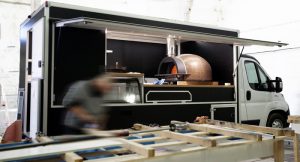
You want to to start your own catering or retail business, while while moving freely and without having to invest in a building? L’fitting out a food truck is the solutionyou need !
Prerequisites for your food truck conversion project
Transforming a truck into a mobile restaurant is no easy task! It’s essential to prepare your project carefully, so that you have every chance on your side.
Conducting market research
Before setting out to organize your mobile vehicle, it’s advisable to carry out market research to identify your target clientele and their expectations, assess the competition so you can stand out from them, define your culinary concept and determine the most promising locations.
Create a solid plan
Drawing up a sound business plan is the cornerstone of any project, as it will help you define your sales strategy, estimate your equipment and personnel requirements, draw up a realistic budget forecast and convince potential investors or partners.
Setting up a food truck is an entrepreneurial project that requires financing. Banking institutions, private investors, public grants… The possibilities are endless! In any case, a solid business plan is essential to convince your potential investors. This must include a detailed market study, your positioning in relation to the competition, and a financial forecast.
Choosing the right truck
There are different types of food trucks, each with its own specific features. For example, a light truck is ideal for squeezing into small streets and setting up easily at a market. Conversely, a heavy truck is less convenient to maneuver, but offers much more space for working or storing products. Choosing the right food truck depends on a number of criteria, such as your budget and long-term sales targets.
Working with design professionals
Calling in the experts can save you time and potentially costly mistakes. Benefit from their experience in fitting out food trucks, and you’ll benefit from an ergonomic layout, advice on the most suitable materials, assistance in bringing your vehicle up to standard, and personalized follow-up.
By calling on a food truck manufacturer like Ecomag, you can also customize your vehicle to attract attention and enhance your mobile restaurant. It also depends on the activity: a snack food truck will have different layout requirements from a pizza truck or a French fry van.
Choosing the right locations
The location of your food truck is of crucial importance. You need to choose strategic locations that will bring you enough customers to make your business profitable. For each location, you also need to find out about the regulations in force. The rules may vary depending on whether it’s a public space, a market, private land…
Complying with regulations
Mobile catering is subject to the same health and safety regulations as conventional catering. You must therefore undergo training with a certified organization before you can work in this field. What’s more, there are specific administrative formalities involved in converting a truck into a food truck, which we describe below.
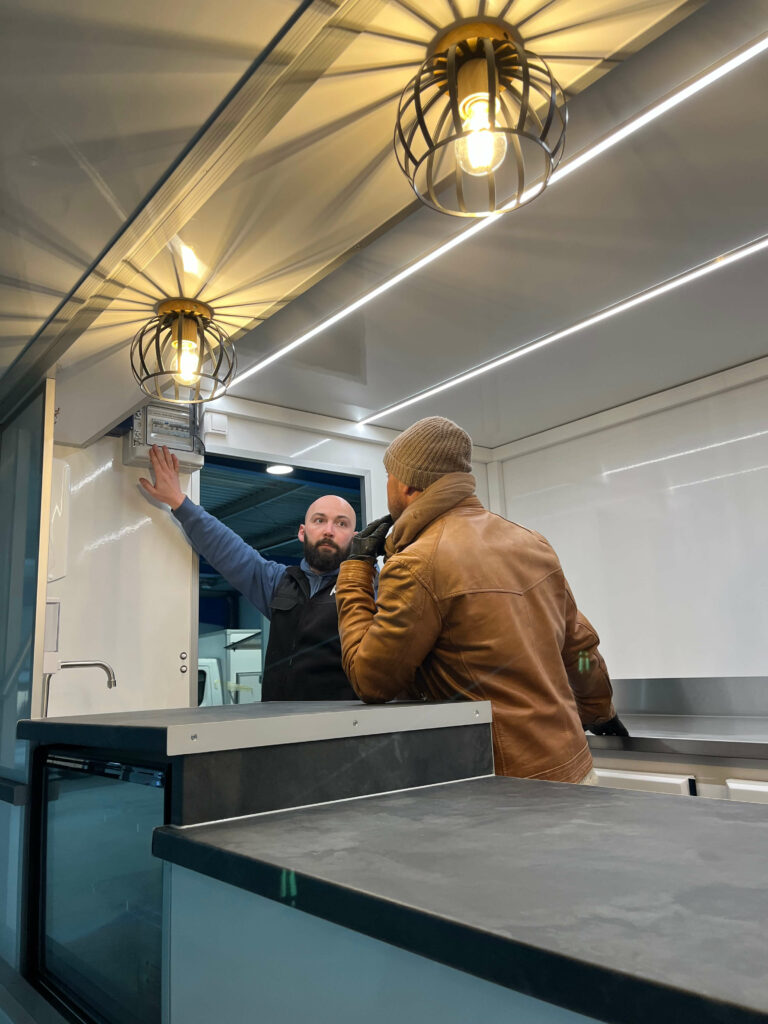
Converting a truck into a food truck: how does it work?
Now that you’ve fulfilled all the necessary prerequisites, it’s time to startconverting your truck into a food truck. The aim is to design a space that’s ergonomic and adapted to your activity, allowing you to work safely and efficiently. However, a truck has a limited capacity, so you need to skilfully exploit every square centimetre to install all the equipment you need.
Essential food truck equipment
The basic principle forconverting a truck into a food truck is to install a special floor, adapted to the layout of the store area.
The bodywork also needs to be fitted with panels and side shutters to enable you to display and sell your dishes. Then, of course, you need to provide all the facilities required for your catering business: worktop, hob, extractor hood, fryer, grill, etc. And let’s not forget refrigerators, freezers and other refrigerated display cases, essential for keeping your products fresh.
We also have to install all the electrical and/or gas systems required to operate the various equipment. Don’t forget the service counter, cash drawer and other accessories: hand-washing basin, soap dispenser, etc.
Can you fit out your own food truck?
When you’re ready to start your own business, you may want to take care of convertingyour truck into a food truck yourself. It’s an economical solution, and you’re guaranteed to get a mobile restaurant that perfectly matches your needs and desires. However, it’s a complex task that requires real expertise in various fields: bodywork, electricity, paintwork… And, above all, theapproval of your mobile truck!
That’s why it’s best to call on a company specializing in food truck design, such as Ecomag.
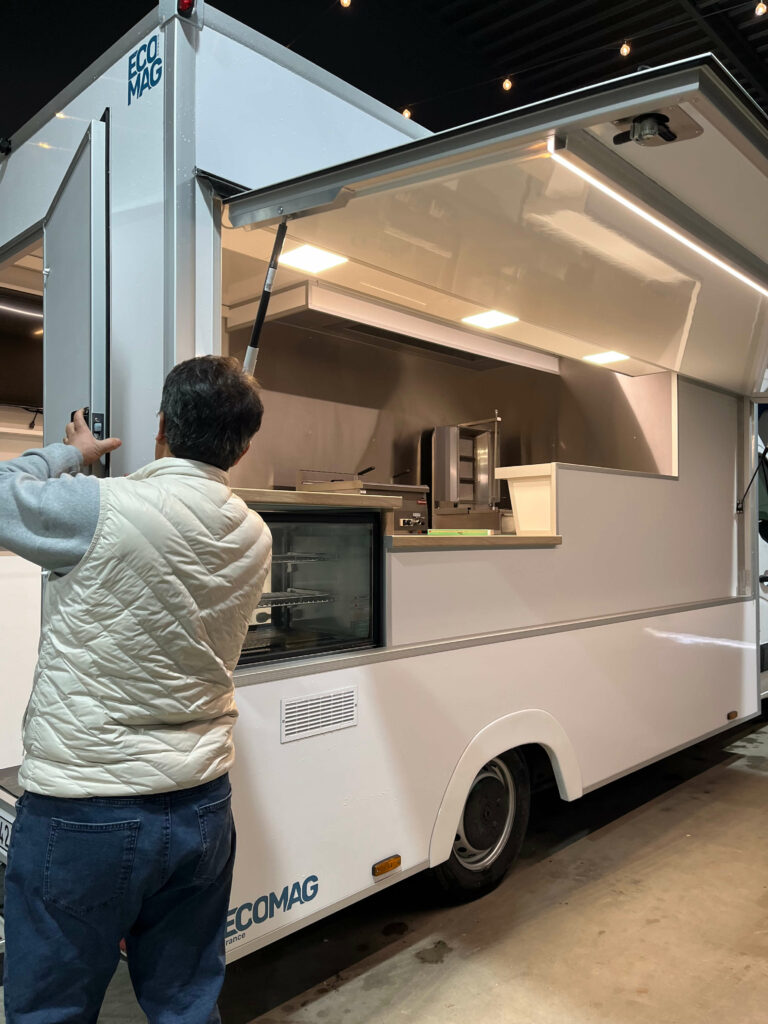
Rules for a food truck that complies with standards
When setting up a food truck, you need to comply with a number of regulations to guarantee the food safety and conformity of your mobile catering business.
Hygiene regulations
HACCP(Hazard Analysis Critical Control Point) standards form the regulatory basis for all food service operators, including itinerant traders. To comply with these standards, your food truck must be equipped with :
- Smooth, washable, non-toxic work surfaces
- Separation of preparation areas to avoid cross-contamination
- Hand-washing system with hot and cold water
- Compliant refrigeration equipment
- Temperature control devices
Foodstuffs must be stored according to the cold chain (between 0°C and 4°C for fresh produce), and raw and cooked foods must always be kept separate. In addition, you’ll need to use hermetically sealed and labeled containers, and ensure stock rotation on a “first in, first out” basis.
Hygiene training for staff
Staff training is the key to maintaining food safety at your food truck. According to French regulations, at least one member of the team must have undergone food hygiene training appropriate to the activity. This training must cover good hygiene practices, HACCP principles, allergen management, cleaning and disinfection procedures, and waste management.
What are the penalties for non-compliance?
Penalties for non-compliance with food truck regulations can be severe, as food safety is at the heart of all food-related businesses. In the first instance, offending food truck owners may receive a formal notice, giving them the opportunity to rectify any identified problems within a set timeframe. If corrections are not made, or if the infringements are deemed more serious, the authorities may order the temporary closure of the food truck until all standards have been met. In the most serious cases, the licenses and permits required to operate the food truck may be revoked, bringing the business to a permanent halt.
Fines can be imposed for various offences, such as failure to comply with hygiene regulations or illegal parking. Fines vary according to the seriousness of the offence, and can accumulate in the event of a repeat offence, representing a substantial cost for food truck owners. In the most serious cases, such as endangering the health of consumers or deliberate fraud, criminal proceedings may be instituted.
Apart from official sanctions, failure to comply with standards can have repercussions on a food truck’s reputation. Losing the trust of customers, bad publicity and difficulty in obtaining new locations or contracts can seriously compromise the long-term viability of the business. That’s why it’s so important for food truck owners to comply with the various regulations and standards in force.
Administrative procedures for converting a truck into a food truck
Owning a food truck is first and foremost a catering business. It is therefore essential to take certain steps to comply with the health and safety standards applicable to this sector.
What is VASP certification?
VASP (Véhicules Automoteurs Spécialement Aménagés)approval is compulsory for all converted vehicles. Without it, it is impossible, for example, to pass the roadworthiness test. Similarly, in the event of a roadside inspection, the vehicle owner is liable to pay a fine of 135 euros if he or she does not have the appropriate approval. There are different types of VASP registration card. In the case of a food truck, which offers a mobile catering activity, the VASP Magasin approval is required (or possibly a VASP Divers registration certificate).
How do I obtain VASP certification?
To obtain a VASP registration document, a certain number of supporting documents must be provided:
- The current vehicle registration document, if the food truck is already registered.
- The Kbis of the company running the food truck.
- A copy of the manager’s identity document.
- Proof of address.
- The certificate of sale, if the vehicle is still in the name of its previous owner.
- Technical inspection report, if applicable.
The application for VASP approval has to be made online, via a dedicated portal: a process that can prove tedious… Purchasing a pre-fitted food truck, however, allows you to get round the problem, as the supplier takes care of all the necessary administrative formalities. As a manufacturer of food trucks, Ecomag makes your life easier by offering you only VASP Magasin-approved vehicles. A gas-approval certificate is also provided on delivery. So you can be sure that you’re buying a vehicle that complies with the regulations applicable to your activity, while freeing you from the most burdensome formalities.
How to apply
There are several steps to certification:
- Register the vehicle modification with the DREAL (Direction régionale de l’Environnement, de l’Aménagement et du Logement)
- Present the vehicle to an approved body for technical inspection
- Obtain the “procès-verbal de Réception à Titre Isolé” (RTI), confirming the vehicle’s individual approval.
- Updating your vehicle registration
Please note that failure to comply with this procedure may result in vehicle immobilization and financial penalties.
Things to remember when setting up your food truck
Designing a work area in a mobile vehicle starts with the creation of an efficient and original food truck layout.
Use available space
In a food truck, every square centimeter counts. This is why the layout must be designed to make the most of the available space, in particular by using multi-functional equipment (combined steam/convection oven), installing vertical storage and high shelving, choosing folding or retractable furniture and creating storage areas under worktops. You can, for example, add stainless steel cupboards and shelves for storing dry ingredients and utensils. Don’t forget to equip your truck with all the necessary appliances (hobs, fryers, grills, etc.) and include refrigerators for food storage.
Create functional zones
The organization of a food truck is based on the clear demarcation of different work zones. The preparation area is the heart of the food truck, and must include a sufficient work surface, suitable cooking equipment and storage space for ingredients. Located close to the window or sales counter, the service area must enable fast, efficient service; provide space for the cash register, condiments and disposable crockery. The storage area is essential for storing provisions, utensils and equipment. Remember to include refrigerators and freezers adapted to your needs.
Visual appeal and brand identity
The exterior of the food truck is your mobile showcase and must be attractive. To achieve this:
- Choose paint in your brand’s colors
- Install an awning or pergola to create a reception area
- Provide lighting for night services
- Clearly display your menu and prices
You can, for example, install panels and side shutters to present your dishes and make your counter more welcoming. A well-presented sign will attract more customers.
In short, what are the main steps involved in setting up your food truck?
Setting up a food truck therefore requires prior market research and a solid business plan, to ensure a solid foundation for your project. When it comes to interior layout and food hygiene and safety regulations, you must never neglect VASP approval, staff training and good management of available space. Taking care of the visual aspect of your food truck by fitting it out properly, and asserting your brand identity will help you stand out from the crowd, attract loyal customers and make your project a real success.
Ecomag helps you turn your truck into a food truck
From planning your project through to the final touches, Ecomag will support you from A to Z in the creation of your mobile restaurant. Specializing in the sale and fitting out of food trucks, we offer a range of new and used vehicles, which we transform to suit all types of catering.