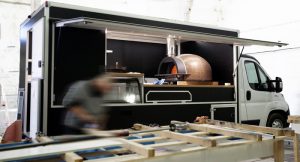
Step-by-step instructions for opening a truck store
The food truck concept has gained immense popularity worldwide. Specially fitted out and equipped to serve as a mobile point of sale, the food and catering truck frees you from the constraints of renting premises, maintenance, etc.
Like food trucks, the store truck has become a veritable institution, enabling shopkeepers to reach their customers more easily. Would you like to get started? Whether you’re a butcher, delicatessen, baker or grocer, EcoMag can build your store truck for you. Choose the truck that suits your needs and ask us for a quote.
In the meantime, here’s all the advice you need to succeed in your nomadic business adventure.
Step 1: Financing: define a business plan, a market study and a provisional budget
The business plan helps you structure your project, assess its financial viability and convince potential investors. You have several options for financing your food truck project:
- Personal contribution: ideally 20% to 30% of the total amount
- Bank loan: the majority of financing, generally over 5 to 7 years
- Business start-up assistance: honor loans, regional subsidies, etc.
- Participatory financing: can supplement your personal contribution
Prepare a solid file to convince banks and potential investors.
Market research into the mobile catering market in your target geographical area will help you refine your concept and stand out from the crowd.
Your financial forecasts must be based on realistic assumptions. Plan for several scenarios (pessimistic, realistic, optimistic) to anticipate contingencies. A well-constructed business plan will increase your chances of success in the competitive world of food trucks.
Prepare your store truck project
Opening a store truck is a real entrepreneurial project that shouldn’t be taken lightly: hence the need to prepare the acquisition well.
Study the profitability of the store truck
Setting up a store truck raises very important issues, particularly from a financial point of view. You need to be sure that your business will be profitable, so that you can cover all the costs involved in purchasing your vehicle, equipment and raw materials, setting up your business, etc.
To carry out this profitability study, you need to calculate your costs as accurately as possible and define a suitable selling price that will enable you to pay your expenses, repay your loans and pay yourself a salary. In fact, it’s a good idea to draw up a detailed business plan before you set up your company.
Step 2: Choose an original concept and find a name
Creating an original concept involves developing a unique identity that will attract customers and build loyalty. Think about the type of cuisine, the ambience and the design of the vehicle. Find a little-exploited niche in the local food truck market and analyze the competition to set yourself apart. Your concept must be consistent.
The name of your food truck is the first thing customers will notice. It should be catchy, easy to remember and reflect your concept. Be creative, simple and to the point.
Step 3: Define your target clientele and your type of cuisine
To target your market effectively, analyze the characteristics and behavior of your potential customers:
- Age, gender, socio-professional category
- Eating habits and special diets
- Budget for fast food
This information will help you fine-tune your concept and offer a cuisine suited to the tastes and expectations of your target audience.
The type of kitchen you choose is crucial to your success in the competitive mobile catering market. Choose a cuisine that you are passionate about and have mastered, while ensuring that it meets the expectations of your target clientele.
Kitchen type | Examples of dishes |
Burgers, hot dogs, fries | |
Nems, sushi, woks | |
Galettes bretonnes, aligot, socca | |
Vegetarian/vegan cuisine | Bowls, mixed salads, wraps |
Once you’ve defined your cooking style, create original, tasty recipes, preferably quick to prepare and easy to eat.
Step 4: Draw up an estimate to finance your business
To finance your food truck, draw up a complete budget forecast, including all the costs involved in launching and running your food truck:
- Vehicle purchase or lease
- Fittings and equipment
- Registration and insurance fees
- Initial raw materials inventory
- Marketing and communication expenses
- Fixed costs (fuel, maintenance, etc.)
- Salaries and payroll taxes
Plan for a safety margin to cover unforeseen events. Don’t hesitate to enlist the help of a chartered accountant to refine your financial forecasts and structure your financing plan.

Step 5: A custom-built or second-hand food truck?
A custom-built food truck meets the specific needs of your business, while a second-hand food truck represents a smaller purchase to get your business off the ground.
Customized food trucks: maximum personalization
Although more expensive, a custom-built food truck can be fully customized to suit the needs of your business, since you can design the workspace and equipment, and ensure that it complies with the latest health and safety standards.
Used food trucks: an economical option
A second-hand food truck is often more affordable for entrepreneurs on a budget. You’ll easily find all kinds of models and be able to get up and running more quickly, but some models need to be brought up to standard, or carry risks in terms of mechanical reliability.
The choice between a custom-built or used food truck therefore depends on the entrepreneur’s objectives, budget and long-term vision for his mobile catering business.
Step 6: Inside the vehicle: finding the right food truck and fitting it out
The interior of a food truck needs to be designed and equipped to work efficiently. Include areas dedicated to preparation, cooking, service and storage. Don’t forget to include space for cashiering and ordering.
The choice of cooking equipment depends on your culinary concept. Provide smooth, easy-to-clean work surfaces, a separate hand-washing basin and an efficient ventilation system. Floors should be non-slip and washable.
Step 7: Register the vehicle and take out food truck insurance
Registering your food truck follows the same procedure as for any other vehicle. Online or at the prefecture, you’ll need to provide a :
- Vehicle transfer certificate
- Proof of identity
- Proof of address
- Completed cerfa n°13750*05 form
- Up-to-date roadworthiness test (if vehicle over 4 years old)
The cost of registration varies according to the tax rating and age of the vehicle. If your truck has undergone modifications in order to be fitted out as a galley, you may need to have it approved by the DREAL before you can register it, to check that the modifications comply with safety standards.
Essential insurance
Several types ofinsurance are required to cover your commercial activity. You’ll need commercial vehicle insurance to cover the commercial use of your truck. Third-party liability insurance is essential to protect your business against the risks associated with your catering activity. It’s a good idea to compare several quotes from insurers specialized in mobile catering, to get the best coverage at the best price.
Step 8: Hygiene standards and food truck regulations
Regulations and hygiene standards govern catering businesses, including food trucks, to guarantee food safety for customers.
Training courses: food hygiene and preservation
Before being allowed to operate, all operators must undergo training in food hygiene and safety, to familiarize them with good hygiene practices, health risks and current regulations. This training must be repeated every 3 years.
Food truck regulations
The food truck must be designed and fitted out to facilitate cleaning and disinfection. Surfaces in contact with food must be smooth, impermeable and easy to clean. A stainless steel worktop is generally recommended.
Maintaining the cold chain is crucial. The food truck must be equipped with refrigerators and/or freezers, and contain closed garbage cans for food waste and packaging. Wastewater must be disposed of in an environmentally-friendly way, using retention tanks. Finally, foodstuffs must be protected from contamination during storage and preparation.

Step 9: Licenses: selling alcohol and selling everywhere
The sale of alcohol and itinerant activities require specific licenses. These permits are essential if you are to operate legally on markets and outside your home town.
Licenses to sell alcohol in a food truck
To sell alcoholic beverages from a catering truck, you need a 3rd category license (sale of non-distilled fermented beverages and naturally sweet wines) or a restricted license (sale of alcohol only during meals). It takes about 2 months to obtain.
Before applying for a license, the manager must undergo training in alcohol prevention and control.
Itinerant merchant card
To operate a mobile sales business outside the commune in which you are domiciled, you must hold a “carte de commerçant ambulant”, issued by the Chamber of Commerce and Industry or the Chamber of Trades and Crafts on which your business depends. However, this card is not required for the sale of products from one’s own farm.
Step 10: Location authorizations
Site permits determine where your mobile catering business can set up and operate. To obtain a site on the public domain, apply for authorization from the town hall of the commune where you wish to set up. On a private site, authorization must be obtained from the landowner.
Some municipalities have set up a system of rotating locations for food trucks, to diversify supply and give all entrepreneurs a chance. So it’s important to find out about these schemes and sign up if you can.
Private pitches
As the name suggests, these are privately owned spaces, such as supermarket parking lots. These spaces are often provided in exchange for rent, although they can also be loaned free of charge.
Public locations
These are parking spaces owned by a municipality or other public body. Their use generally requires a parking permit. These spaces may be provided free of charge by the local council, but you may also have to pay a fee to use them.
The markets
Food markets are strategic locations for setting up a mobile truck and quickly making yourself known to a wide customer base. To obtain a site, you generally need to contact the town hall of the commune where the market is located, to obtain authorization.
In addition to location authorizations, your food truck will have to comply with local regulations on authorized operating hours, waste management and public space cleanliness, noise pollution and vehicle parking outside operating hours. Failure to comply with these rules may result in penalties ranging from fines to withdrawal of the site permit.
Step 11: Choose a legal status and obtain a business license
There are several legal forms available for setting up a food truck business.
Micro-enterprise is a simplified system for small businesses with limited sales. Formalities are reduced and accounting is streamlined.
Sole proprietorships are ideal for solo entrepreneurs. It does not require a minimum capital contribution.
Finally, the SARL (Société à Responsabilité Limitée – limited liability company) allows several people to form a partnership. Liability is limited to the contributions made, but the formalities involved in setting up and managing the company are more complex.
Step 12: Start your mobile catering business
Setting up a food truck requires meticulous preparation, from project conception to completion. Its success depends on the originality of the concept, financial management, compliance with hygiene standards and regulations on food truck locations and sales conditions.
How to choose your store truck?
There are many different types of warehouse truck, with a wide range of options to choose from. So much so that it can be difficult to choose the right vehicle for your business.
Les différents types de camions magasins
Today, there are store trucks specially designed for all trades, such as :
- Pizza: Pizza truck, choosing your oven and all the fittings that go with it.
- Bakery: Choose a mobile bakery and connect with customers
- Ice cream: Become an itinerant ice cream maker and serve the finest Italian ice creams
- French fry shop: for fry cooking and burger preparation, your truck needs to be functional to be efficient during rushes.
- Butcher Shop and Deli Truck
- Fishmonger’s
- etc…
Each one is equipped with specific features that allow professionals to do their jobs under the best possible conditions every day. In addition, there are mobile stores that vary in size, capacity, and appearance. From light-duty vehicles to heavy-duty food trucks, from the most vintage models to the most modern ones, you’ll be spoiled for choice…. Even so, there are a number of criteria that any store truck must meet:
- The vehicle must have a VASP registration certificate.
- It must be equipped with professional cooking equipment, adapted to your activity.
- Facilities must comply with health and safety standards.
Should I buy a new or used store truck?
When it comes to buying a warehouse truck, the question inevitably arises: should it be new or used? In reality, there’s no definitive answer to this question, as each option has its own advantages. With a new store truck, you can customize it as you wish, whether in terms of bodywork, decoration, layout or equipment. What’s more, you’re guaranteed to acquire a vehicle in perfect working order. But buying a used mobile truck can also be a very interesting solution. It allows you to acquire a ready-to-use truck quickly, at an attractive price. However, it won’t be as customized as a new vehicle.
Rules to follow when buying a store truck
When you open your truck store, you’ll need to take a number of compulsory steps, starting with HACCP training in food hygiene and safety. This must be carried out by an accredited organization. You also need to make sure that your food truck’s fittings comply with the same hygiene rules.
Don’t forget to take out insurance for your vehicle and your business. Today, there are insurance policies specially designed for store trucks.
Finally, if you haven’t already done so, you need to complete all the formalities involved in setting up your business, depending on the status you have chosen: auto-entrepreneur, sole proprietorship, etc.