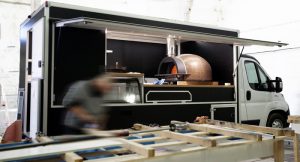
Are you thinking of opening a food truck to turn your passion for cooking into a real adventure? But you don’t know where to start so you don’t forget anything and build a solid project. This guide has been written to take you step by step through the process.
How to open a food truck
Discover the 5 steps to follow to open your food truck.
1. Define your mobile catering project
There’s no point in starting out without a roadmap. The first step is to define your project and make sure it’s viable and can be realized.
Prepare for your future profession
Our recommendations for getting off to a good start, for future entrepreneurs who are starting from scratch:
1- Immerse yourself in the realities of street vending and catering with an immersion course (PSMP).
2- Attend training courses offered by organizations such as the CCI, BGE and France Active to acquire skills in :
- accounting and administrative management ;
- logistics organization ;
- customer relations and communication ;
- strategy and financing.
3- Assess your entrepreneurial potential by taking the 3 tests offered by the Chamber of Commerce and Industry: “Character traits”, “Determination and motivation”, and “Resources and aptitudes”.
Choose an original concept
The success of your food truck depends above all on a clear and original concept. To set yourself apart from the competition, you can play on :
- the type of food and dishes offered(burgers, tacos, world cuisine, vegetarian, sweet…), ideally if you have a unique culinary specialty that sets you apart from the competition and attracts customers, go for it!
- the type of offer proposed, such as a 100% takeaway offer, designed for fast, convenient consumption and guaranteeing an impeccable taste experience, for example? Think also of click and collect, online ordering, delivery services, etc.
👉 Discover food truck ideas that work
Identify your target customers
Identify precisely whom you are addressing:
- Students on campus, looking for early, tasty and affordable meals between classes;
- Employees in office or industrial zones, who want a quick, high-quality catering option during their lunch break:
- The general public, at events, markets, festivals or professional seminars, looking for a unique, hands-on culinary experience;
Knowing your customers is the basis for guaranteeing a tailored offer that will work.
Project profitability
Not all food trucks are created equal in terms of profitability. It’s important to think ahead:
- margins on the products offered;
- the cost of raw materials and expenses ;
- sales frequency (daily, event-driven, seasonal, etc.).
Conducting market research for your food truck
Market research for your food truck is an essential step in validating your idea. It allows you to :
- analyze local demand and consumer habits,
- identify direct competitors (other vans and fast-food outlets),
- assess the opportunities and constraints specific to your geographical area.
You can use questionnaires, field observations, INSEE or CCI data.
Drawing up a business plan for your food truck
You must also draw up a complete food truck business plan that includes :
- a market and competition analysis,
- concept presentation,
- sales and marketing strategy,
- a financial plan detailing investments, expenses, projected revenues and break-even point.
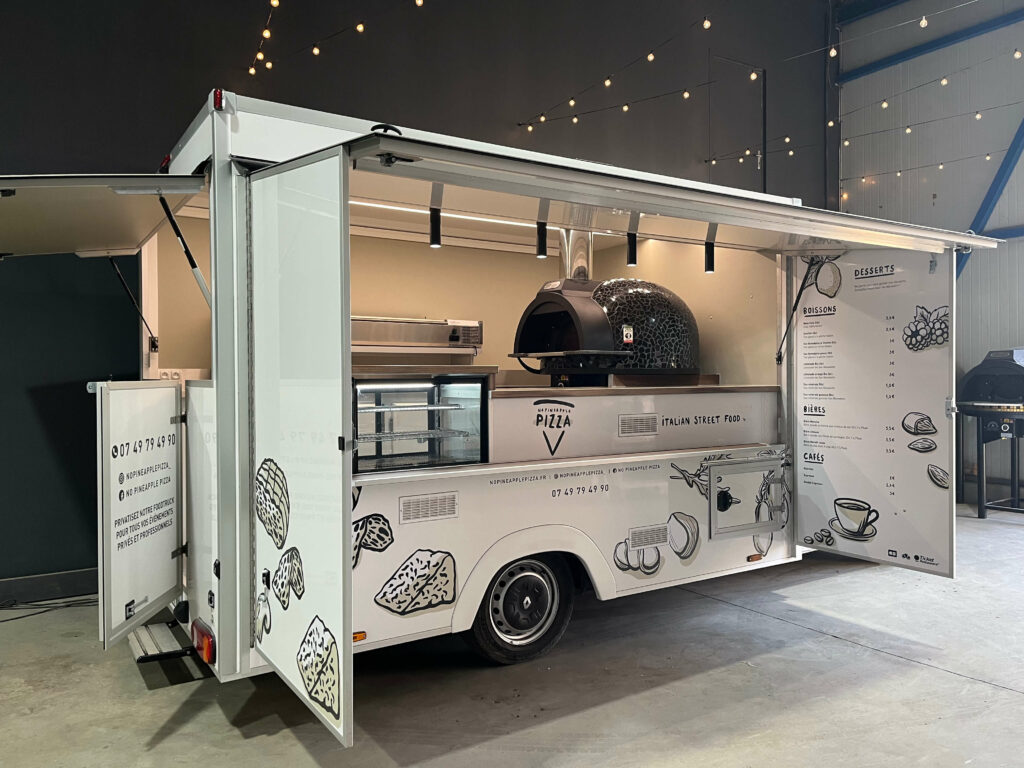
2. Choose the right legal status for your company
You need to choose your status carefully, as it will have an impact on your tax regime, social security benefits and accounting obligations.
Legal status
Depending on your personal situation, your growth ambitions and your need for protection, you can opt for :
- micro-business: simplified system, ideal for starting out on your own with low charges,
- sole proprietorship (EI ): flexible status with streamlined operations,
- a company (SAS, SASU, SARL, EURL): more formal, suitable if you plan to join forces or expand your business.
Note: to help you make the best choice for your profile, Urssaf provides a quick and easy online simulator.
Administrative procedures for food trucks
Since January 1, 2023, all procedures for setting up a business have been carried out via INPI’s Guichet unique. Here are the steps to follow to register your van:
1- Create your personal account: start by creating an account on Guichet unique. Once logged in, go to the “business” section and click on “submit a business form”.
2- Fill in the 8-page interactive form. If you have any doubts, a detailed guide is available online to guide you through the process.
3- Registration: once these steps have been completed, your restaurant is registered with the Répertoire National des Entreprises (RNE) and the Registre du Commerce et des Sociétés (RCS). You will then receive a SIREN number, a SIRET number and a Kbis extract.
Note: Before opening your mobile restaurant business, you must declare it to your local town hall. This formality must be carried out at least 15 days before the opening of your establishment.
3. Choosing your vehicle and equipment
The choice of vehicle and equipment is decisive in ensuring the smooth running of your food truck and quality services that comply with health and safety standards.
The vehicle
Are you hesitating between a truck or a trailer to launch your food truck? Here are a few tips to help you decide.
The advantages of a food truck:
- It’s ready for use as soon as you switch off the engine.
- However, in the event of a breakdown, your service is stopped.
The pros of a trailer :
- The trailer is a good option if you have a tighter budget or a one-off operation.
- It requires an adapted towing vehicle and fixed or temporary parking to install it.
- Installation takes longer. You have to unhitch it, fix it and balance it.
The equipment
To ensure that your food truck runs smoothly, here is a list of equipment to consider:
| Type of equipment | Equipment details |
|---|---|
| Cooking equipment |
|
| Cold storage equipment |
|
| Hygiene equipment |
|
| Safety equipment |
|
4. Registration, license and approvals
The GVW (Gross Vehicle Weight Rating) indicates the type of license required.
- If your truck weighs less than 3.5 tonnes, all you need is a B licence.
- For a truck > 3.5 tonnes, you need a heavy goods vehicle license, type C or C1.
- For a trailer, if the GVWR exceeds 750 kg and the total mass (vehicle + trailer) exceeds 3,500 kg, you’ll need a B license with a one-day training course. Above 4,250 kg, you need a BE license.
Your truck or trailer must be VASP (Véhicule Automoteur Spécialement Aménagé) approved. This approval from the Dreal guarantees that the van meets the required safety and hygiene standards.
5. Professional insurance
Operating a mobile catering service means covering the risks associated with operations, the vehicle and customer safety.
Compulsory insurance for complete coverage
As a restaurateur, here are the insurances you need:
- Professional Civil Liability (RC Pro): covers damage caused to third parties (bodily injury, property damage, consequential loss).
- Comprehensive insurance: protects your equipment, stock and business in the event of a claim. At Ecomag, we’ve had excellent feedback from itinerant traders who take out their insurance with MAPA.
Vehicle insurance to protect your food truck
Your food truck must be insured as a professional VASP vehicle, with cover adapted to its use (fire, theft, breakage, breakdown…).
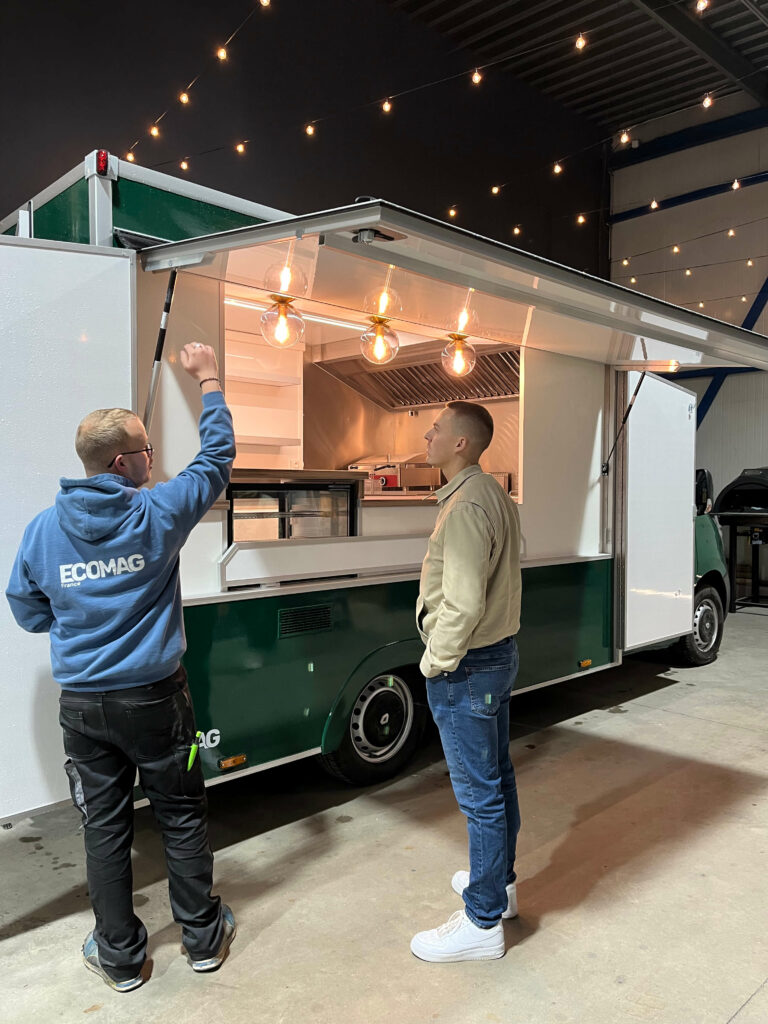
Food truck costs
Launching a food truck involves a significant initial investment, spread over several key areas.
Initial investment
Your initial budget is broken down into several items:
- Buying a food truck* or trailer**: from €5,000 to €100,000, depending on whether you get it used or new.
- Fixtures and fittings: allow between €10,000 and €30,000, depending on the equipment you need for your business.
- Start-up stock: around €1,000 to €3,000, depending on the products you offer.
- Administrative costs and training: between €500 and €2,000, for procedures, insurance, permits, etc.
- Communication (logo, flyers, media): from €500 to €2,000, depending on whether you use a graphic designer or an agency.
Note: renting a truck or trailer can be a good way to get started without taking too many risks.
*The new cost varies between €30,000 and €50,000 for a used truck, and between €50,000 and €100,000 for a new one, depending on the type of equipment.
** The new cost varies between €5,000 and €20,000 for a used trailer, and between €12,000 and €40,000 for a new one, depending on the type of equipment.
Operating expenses
Once you’ve launched your food truck, you’ll need to anticipate the recurring operating costs that will keep it running smoothly.
Fuel and vehicle maintenance
As a food truck is a mobile business, fuel is a significant expense, especially if you regularly travel to different locations (markets, events, businesses).
Routine vehicle maintenance (oil changes, tires, repairs) must also be included in the monthly budget, to guarantee the safety and reliability of your equipment.
Renewal of raw materials
Food stock must be renewed frequently to guarantee the freshness and quality of your products. This expense item represents a significant proportion of monthly costs, and depends on the type of cuisine offered, sales volume and seasonality. Good supply management helps limit losses and optimize margins.
Royalties and miscellaneous expenses
- Location: parking fees can range from €5 to €50 per day, depending on the city, the length of occupancy, or the nature of the event.
- Insurance: you’ll need to pay an annual or monthly premium for professional liability, vehicle insurance and, if necessary, comprehensive professional insurance.
- Hygiene: budget for cleaning products, sanitary checks and replacement of hygiene equipment (gloves, towels, containers, etc.).
For a profitable food truck, these operating costs need to be closely monitored. Good logistics organization and rigorous purchasing management are key to optimizing costs.
Financing a food truck
The financing of a food truck can benefit from various forms of public assistance and support, such as subsidies, low-interest loans and specialist advice. Such support is offered by the State, local authorities and business start-up organizations.
Public assistance and support
Several public schemes and support networks can help you turn your project into reality:
- ACRE (Aide à la Création ou Reprise d’Entreprise): partial exemption from social security charges during the first year of business, subject to conditions.
- ARCE (Aide à la Reprise ou Création d’Entreprise): possibility of receiving part of your Pôle emploi entitlements in the form of capital to finance the start-up.
- Public subsidies for food trucks: some local authorities (regions, départements, town halls) offer specific subsidies for the creation of mobile businesses or for the local economy.
- Support networks:
- CCI (Chambers of Commerce)
- BGE (national support network for entrepreneurs)
- France Active (guarantees, support, solidarity financing)
- ADIE (support and micro-credits for entrepreneurs)
- Réseau Entreprendre, Initiative France: personalized support and interest-free loans.
Conventional financing
Traditional financing solutions can also help you cover all or part of the necessary investments.
- Professional bank loan: available if you have a good business plan and/or a guarantee (personal or external).
- Micro-credit: for small projects or entrepreneurs without access to conventional bank loans.
- Honor loans: granted by networks such as Initiative France or Réseau Entreprendre, these loans are interest-free and unsecured. It is often used as leverage to obtain a complementary bank loan.
Alternative financing
In addition to, or in place of, conventional aid, alternative solutions are available to mobilize funds in innovative ways.
- Crowdfunding food truck: another way to finance your business via platforms like Ulule, KissKissBankBank or Tudigo. You can raise funds from the general public. This also allows you to test the concept before launching.
- Leasing or long-term rental: the ideal way to limit your initial investment. You can rent a truck or certain equipment (ovens, refrigerators, display cases) over several years.
- Personal contribution + local fund-raising: even a small personal contribution can convince local investment clubs, community groups or partners interested in the economic or food development of their area.
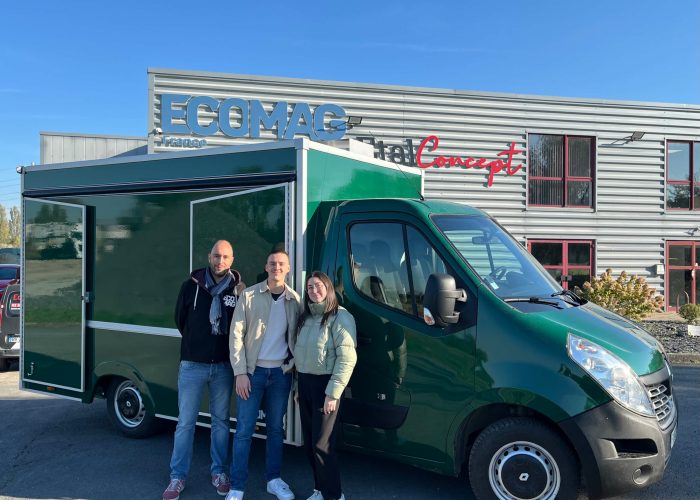
Regulations for food trucks
The food truck business is governed by specific regulations. Here are the main obligations you need to meet to be in compliance.
Itinerant merchant card
If you sell outside your commune of residence, you must apply for a carte de commerçant ambulant (valid for 4 years) from the CCI. If an employee travels on your behalf (with or without you), he or she must have a copy of your card.
To obtain a travelling salesman’s card :
- Fill in form n°14022.
- Send it to the CCI (Chambre de Commerce et d’Industrie) if you’re a merchant, or to the CMA (Chambre des Métiers et de l’Artisanat) if you’re a craftsman or artisan-commerçant.
- You can send them by e-mail, post or on site.
Location for your food truck
Choosing the right location is crucial to attracting loyal customers and ensuring profitability. You need to target popular areas and comply with local regulations to obtain the necessary permits.
How to choose a location for your food truck
Here are a few tips for choosing a location for your food truck:
- Focus on high-traffic areas: opt for busy places like city centers, events or business districts.
- Analyze the competition: choose a location where there is demand, but not too much direct competition.
- Ensure accessibility: the location must be easily accessible for your customers and comply with local regulations concerning the installation of food trucks.
Site authorizations
First of all, you need to :
- be registered (have a Siren number),
- have taken out professional insurance.
Next, the permits you need will depend on the location you are planning to visit:
- On a market for a fixed or floating space: send your request to the town hall or to the market manager.
- On a sidewalk or public square: obtain a parking parking permit for your food truck or a temporary occupation permit (AOT) from the town hall.
- At a festival, fair or event: contact the organizer directly to reserve a stand.
- In a private area (garden, store, parking lot, courtyard): obtain written consent from the owner of the premises. Additional checks are required:
- Make sure your business complies with the local town planning scheme (Plan Local d’Urbanisme or PLU).
- Depending on the nature and frequency of the activity, a declaration to the town hall or prefecture may be required.
Hygiene rules
You have several obligations:
1- HACCP training: training in food hygiene (HACCP) is mandatory for any catering business. This training must be taken by at least one member of the company. Find out more about food hygiene training funding schemes
2- Health declaration: if you handle food of animal origin (meat, fish, eggs, milk, etc.), you must declare your activity to the Direction Départementale de la Protection des Populations (DDPP).
3- Good Hygiene Practices (GHP): for proper preparation in compliance withfood hygiene rules, you must :
- respect the cold/hot chain to ensure food safety,
- regularly clean and disinfect the truck, equipment and work surfaces,
- wash your hands frequently, tie back your hair and wear clean clothes,
- strictly separate raw and cooked products to avoid cross-contamination.
4- Hygiene and safety: the essentials on board your food truck. To operate legally and guarantee food safety, your food truck must be properly equipped. Here are the essentials:
- access to drinking water and sewage disposal,
- a suitable storage area complying with health standards (temperature, product separation, etc.),
- a hand-washing basin equipped with soap and single-use towels,
- a food thermometer to check the temperature of foodstuffs and ensure their preservation.
5- Traceability and inventory management: to guarantee the safety of your customers, rigorous traceability is essential. It enables you to trace products back to their origin, and quickly withdraw a batch in the event of a health problem. Remember to keep all invoices and labels: they are your proof in the event of an inspection.
Sale of alcoholic beverages to take away
The sale of alcoholic beverages over 18° (rum, vodka, whisky, etc.) is prohibited in food trucks, regardless of time or location.
You may, however, sell beverages under 18° (wine, beer, cider), under certain conditions:
- Before 10 pm: a prior declaration must be made to the town hall (or to the prefecture if the company is based in Paris or Alsace-Moselle), at least 15 days before the start of the activity.
- Between 10 p.m. and 8 a.m.: you need a takeaway license and a PVBAN permit (Permis de Vente de Boissons Alcooliques la Nuit), obtained after a compulsory 20-hour face-to-face training course at an approved center.
Source: the law on street vending (article L3331-4 of the French Public Health Code).
Display rules
In a food truck, a number of displays are compulsory and must be clearly visible to your customers.
- Business license: if you sell alcohol, remember to display your takeaway license.
- Protection of minors: you’ll need to remind people that it’s forbidden to sell alcohol to anyone under 18, as well as the rules against public drunkenness.
- Non-alcoholic beverages: at least 10 different non-alcoholic beverages must be on display for customers to see.
- Meat origin: for all meats (beef, pork, poultry, mutton), indicate the country of birth, rearing and slaughter, either on your menu or on a flyer.
Note: In the event of an inspection, failure to comply with these rules can result in a fine of up to €7,500 and suspension of your license.
Things to remember
Opening a food truck is much more than a simple catering project: it’s an opportunity to live out your culinary passion in complete freedom, while meeting the challenges of entrepreneurship. From administrative formalities to concept selection, investments and regulations, every step counts in building a solid, profitable business. With the right preparation and the right accompaniments, you can launch your food truck with peace of mind and win over your future customers. Now all you have to do is get started!
And to equip yourself with a food truck adapted to your needs, new or used, without compromising on quality and safetytrust in Ecomaga recognized specialist in catering trucks and trailers. Discover our available models and our personalized advice to bring your project to life with complete confidence.